

Handoff research
Why do virtual assistant call transfers fail before the owner receives the work?
Evidence-led research on transfer failures, fallback ownership, and safe continuity for virtual assistant call center operations.
Research question
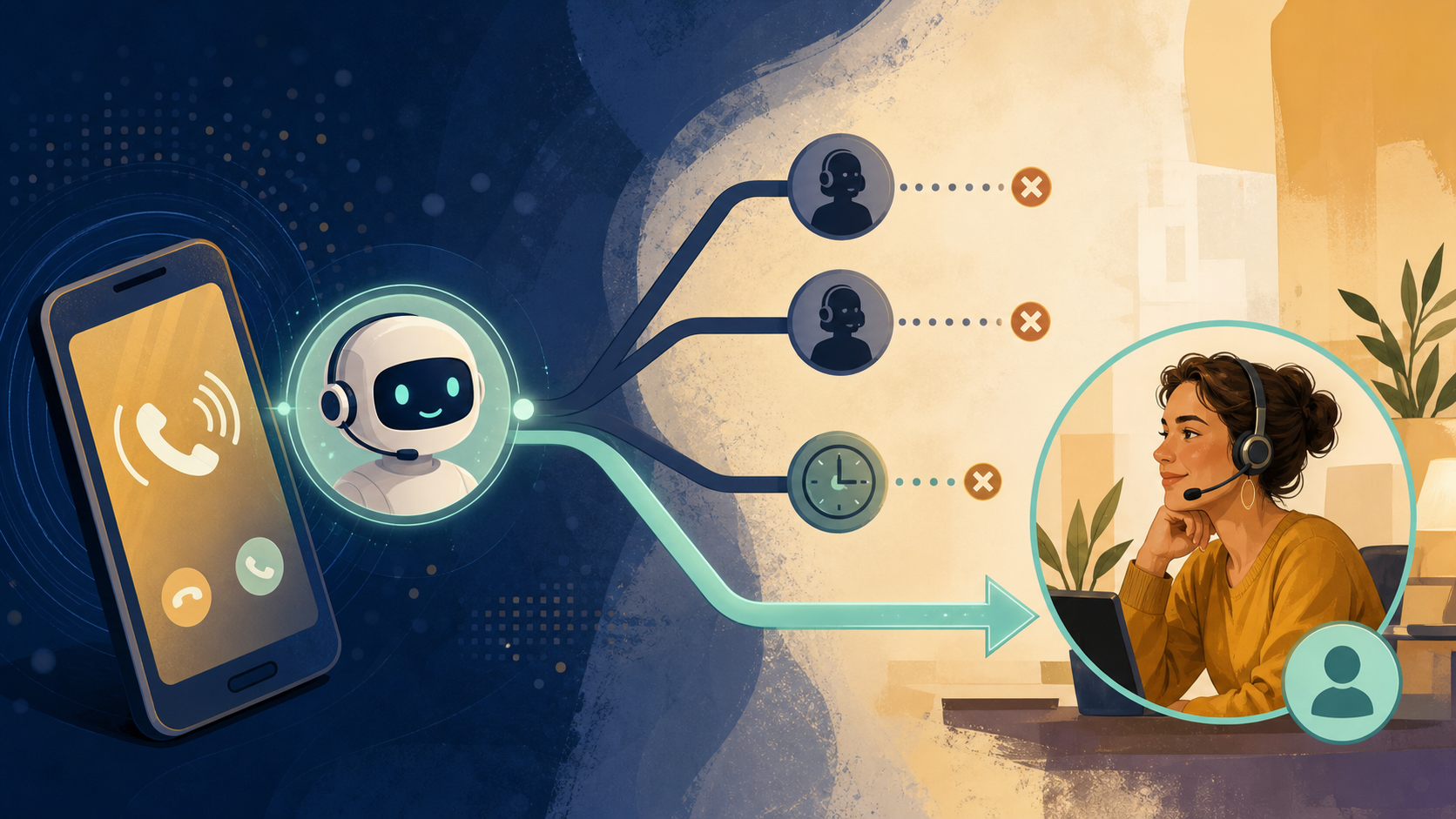
Why does a call transfer fail, and what fallback preserves the caller’s request without pretending that the transfer succeeded? In a virtual assistant call center, “transferred” can mean the receiving line rang, the owner answered, the system created a task, or the assistant simply initiated a blind handoff. Those are different events. A useful study therefore examines the chain from transfer attempt to verified ownership. The question matters for appointment setting, customer support, lead follow-up, and intake because a broken transfer can become an untracked promise.
Methodology and evidence scope
This review draws on the BLS description of customer-service work, NIST incident-handling guidance, CISA communication and phishing guidance, the FCC guidance on unwanted calls, and the ITU emergency telecommunications material. They provide context for routing, incident evidence, suspicious calls, and the fact that urgent paths require local authority. They do not give a transfer-success benchmark for a virtual assistant business. Study one fixed sample of transfer events and record the originating interaction, transfer type, destination, ring or connection result, fallback action, owner acknowledgment, and final disposition. Count missing events as missing evidence, not as failed transfers by assumption.
Failure modes are not interchangeable
A transfer can fail because the destination is closed, because the number is invalid, because no one answers, because the receiving person declines the call, because the caller hangs up, or because the assistant lacks permission to send the information. Each failure calls for a different remedy. A closed destination may need an approved callback queue. A wrong number needs directory maintenance. A privacy concern needs a narrower note. A caller who hangs up may need no outbound action at all unless consent and an approved policy exist.
Separate technical outcome from operational outcome. “No answer” is a phone event. “Owner notified” is a workflow event. “Matter resolved” is a business outcome that may require facts the assistant cannot observe. If a report uses one label for all three, managers cannot tell whether to repair a phone tree, clarify role permissions, or coach note-taking.
A transfer evidence model
| Event | Evidence to retain | Responsible question |
|---|---|---|
| Offer | Reason and approved destination | Was the route appropriate? |
| Attempt | Timestamp and transfer mode | Did the system initiate it? |
| Result | Ring, connection, decline, or failure | What actually happened? |
| Fallback | Message, task, callback, or escalation | Was the next step authorized? |
| Acknowledgment | Owner or queue acceptance | Did ownership become visible? |
| Closure | Disposition or remaining exception | Is the item truly finished? |
Use a unique interaction identifier where the business already has one, but do not copy unnecessary personal data into every system. The study should also record the route version or business-hours rule in force. Otherwise a later comparison may treat a policy change as a quality change. Sample ordinary transfers and high-risk exceptions separately; averages can hide failures concentrated in a sensitive route.
Implications for a virtual assistant call center
An assistant can announce a transfer, attempt a documented route, and create a fallback task when the script permits it. It can read back the next step and avoid promising a response time that no owner has accepted. It should not disclose more information than the destination needs, decide whether an urgent situation is safe, or make a legal, clinical, financial, or fraud determination. For those conditions, the route should name the responsible business owner or approved emergency instruction.
The practical intervention is often a verified fallback, not a more optimistic greeting. If the destination does not answer, the assistant can offer the approved callback path, capture the request, state the actual next step, and mark the item pending. That preserves continuity while making the limit visible. Managers can then review failure clusters by destination, hour, intent, and script version.
Limitations and boundaries
Phone logs may omit callers who abandon before identification, and systems may disagree about timestamps. A transfer record cannot establish whether the owner later solved the underlying issue. The study also cannot determine consent, recording legality, emergency policy, or data-retention requirements for a particular jurisdiction. Those rules need local review. Public reporting should use aggregate operational descriptions and avoid exposing caller content.
The sample should also record whether the assistant had a live directory, whether the destination’s hours were current, and whether the caller was told what would happen next. These contextual fields help separate an assistant behavior from a broken configuration. A failed transfer caused by an outdated route should not become a coaching finding, while a missing fallback after a known outage should remain visible as an operating control gap.
Do not use transfer completion as a proxy for revenue, satisfaction, safety, or compliance. A high connection rate could still conceal bad routing. A low connection rate could reflect an intentionally conservative escalation path. Interpret results alongside route purpose and owner authority.
Evidence-led conclusion
Transfer reliability is a chain of observable events, not a single phone statistic. A virtual assistant call center should distinguish attempt, connection, fallback, acknowledgment, and closure, then study where evidence disappears. The research supports verified fallback ownership and route-specific review. It does not justify promising that every transfer will connect or that a transfer record proves the caller’s problem was resolved.
Sources
1. NIST Computer Security Incident Handling Guide 2. CISA phishing guidance 3. FCC unwanted calls guidance 4. U.S. Bureau of Labor Statistics, customer service representatives