

Tier 1
Executive Assistants
$10/hour
Philippines-based support for structured executive and administrative work.
- Role and task scoping
- Philippines-based candidate matching
- Onboarding and handoff planning
Public hourly tiers
Choose a tier for the complexity of the approved work, then document the schedule, systems, boundaries, and review owner before launch.
Scope my support lane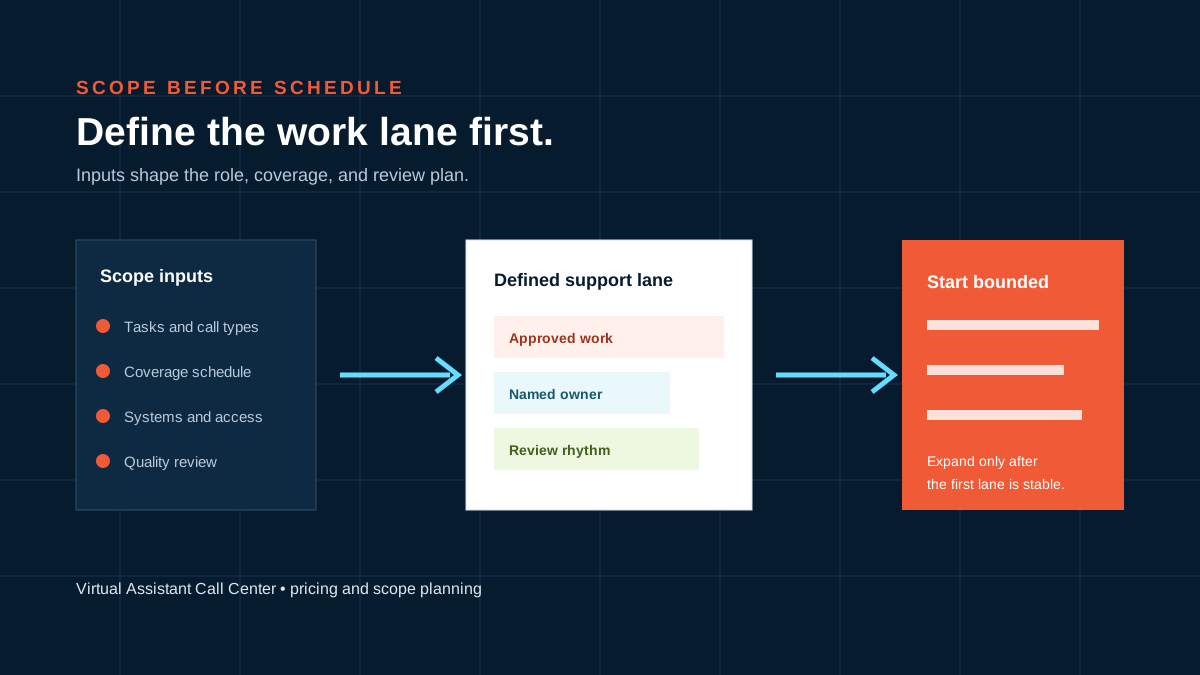
Tier guide
These public tiers describe the support level. They do not replace intake or promise that every task belongs in every tier.
Tier 1
$10/hour
Philippines-based support for structured executive and administrative work.
Tier 2
$15/hour
Experienced Philippines-based support for specialized workflows and coordination.
Tier 3
$18/hour
Philippines-based operational support for complex work lanes and leadership follow-through.
Scope inputs
List the exact calls, messages, updates, or coordination work the role may complete.
Define business hours, time zone, overlap, holidays, and any after-hours expectations.
Name the phone, calendar, CRM, help desk, inbox, and fields required for the approved lane.
Keep refunds, policy exceptions, sensitive account changes, and professional advice with a named manager.
Choose the records or call samples a manager will check during the first weeks.
Included in planning
Launch sequence
Share the calls, systems, hours, examples, and owner-only decisions.
Set access, scripts, record fields, escalation paths, and acceptance checks.
Inspect the first work sample and correct the workflow before adding scope.
Pricing questions
They are the approved public hourly tiers. The suitable tier and expected hours still depend on the documented role, schedule, systems, and management requirements.
Yes. A bounded first lane is easier to train and review than a broad queue with unclear exceptions.
Confirm every required phone, CRM, calendar, help-desk, or specialist tool during intake. Do not assume an external subscription is included in the hourly tier.
Your named manager keeps decisions outside the written scope. The assistant records the context and routes the exception.
Build your first call lane
Share your call types, hours, systems, and escalation rules. We will map a practical coverage plan around your workflow.
Book a free consultation