

Appointment research
Which intake fields prevent virtual assistant appointment errors?
Research on the minimum appointment-intake fields a virtual assistant call center should validate before booking or escalating a request.
Research question
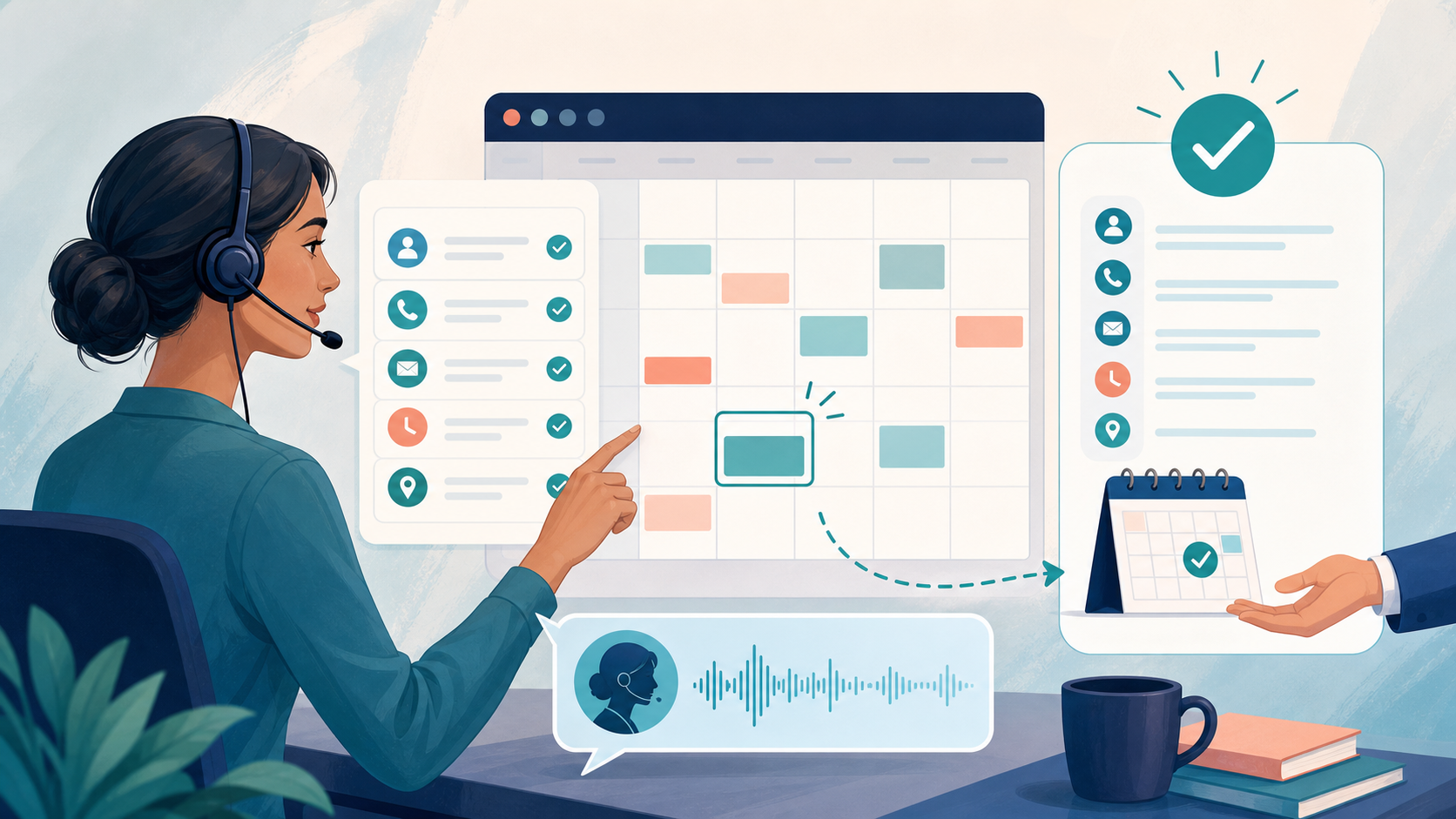
Which appointment-intake fields prevent avoidable booking errors when a virtual assistant call center gathers information by phone? A booking record can look complete while still lacking the details that determine whether the appointment is appropriate, reachable, and owned. This study focuses on field quality rather than booking volume. It asks whether the record contains the caller’s requested service, the correct person or account, a workable contact path, the approved time context, and the next owner. It does not ask the assistant to make a clinical, legal, or professional judgment.
Evidence scope and method
The source set includes NIST Digital Identity Guidelines, W3C WCAG, the U.S. Department of Health and Human Services HIPAA privacy guidance, the BLS customer-service occupational description, and the National Institute of Standards and Technology Privacy Framework. These sources address identity, accessible communication, sensitive information, service records, and minimization. They do not establish a universal appointment form or error rate. Review a fixed sample of booked, rescheduled, and escalated calls. For each record, test whether an independent owner can identify the requested service, intended attendee, contact method, time-zone assumption, confirmation state, and unresolved question without relying on memory.
Why “name and time” is not enough
Two callers can request the same time for different services, locations, or staff members. A short name may match multiple records. A phone number may be mistyped or belong to someone who did not authorize contact. “Tomorrow afternoon” is not a stable appointment value until the business’s time zone, date, and approved availability are clear. A virtual assistant should read back the material booking facts in plain language and mark any field that remains uncertain.
The correct minimum differs by business. A local service business may need service type and address zone; a clinic may need the appointment type and approved patient-matching procedure; a legal intake team may need matter category without asking for unnecessary case detail. The research question is therefore not “what is the universal required field?” It is “which fields are necessary for this business’s documented route, and can another owner validate them?”
Field-level review design
| Field | Validation test | Safe response to uncertainty |
|---|---|---|
| Requested service | Matches an approved service label | Ask a bounded clarifier or escalate |
| Person or account | Matches the business’s approved identity process | Do not guess a record |
| Contact path | Read back the chosen number or channel | Ask for correction and consent where required |
| Time context | Includes date, time, and relevant zone | Offer approved windows only |
| Confirmation state | Shows proposed, booked, or pending | Do not call proposed “confirmed” |
| Owner | Names the queue or person for the next action | Create an explicit exception |
The reviewer should record both missing fields and misleading fields. A wrong service label may be more consequential than a missing optional preference. Weighting can be used for internal review, but publish the weights and do not convert them into a universal benchmark. If the sample is small, report counts and examples of failure modes rather than a percentage with false precision.
What a virtual assistant may and may not do
Within an approved script, the assistant can ask the required questions, repeat back the proposed appointment, book a permitted slot, send a confirmation through the approved channel, and create a note. It should not infer eligibility, diagnose a symptom, select a legal strategy, guarantee an outcome, or override a calendar restriction. When a caller asks for an exception, the record should preserve the request and route it to the business owner.
Accessibility is part of data quality. A caller may need the question repeated, a different communication channel, or a slower exchange. WCAG is a digital standard rather than a phone-call performance score, but its emphasis on understandable and robust interaction is a useful design prompt. Do not treat an accessibility accommodation as an error or force a caller into a channel that the business has not approved.
Limitations and privacy boundaries
This study cannot prove that a validated booking will be attended or that the caller received a reminder. It cannot determine the lawful basis for recording, the retention period, or the minimum identity proof for a particular organization. In sensitive settings, follow the organization’s privacy and security rules and avoid placing unnecessary health, financial, or case information in general call notes. A field can be operationally useful while still requiring restricted access.
Calendar systems can also change after the call. Preserve the timestamp and confirmation state used in the study. If the booking was edited later, treat that as a separate event rather than evidence that the original intake was correct.
Evidence-led conclusion
Appointment quality depends on a small, business-specific set of validated fields, not on collecting every possible detail. For a virtual assistant call center, the defensible method is to define the required fields by route, test them with an independent reviewer, and separate proposed, booked, pending, and escalated states. The evidence supports read-back, explicit uncertainty, and owner review. It does not support universal intake requirements or a claim that accurate fields guarantee attendance or professional suitability.
Sources
1. NIST Digital Identity Guidelines 2. W3C WCAG overview 3. HHS HIPAA privacy guidance 4. NIST Privacy Framework 5. U.S. Bureau of Labor Statistics, customer service representatives